Saturday, April 21, 2012

Hohokam Meet 4/20

Ok -so i know its been a while since i have posted videos... so here it goes. im working backwards through the camera - so check the title/date

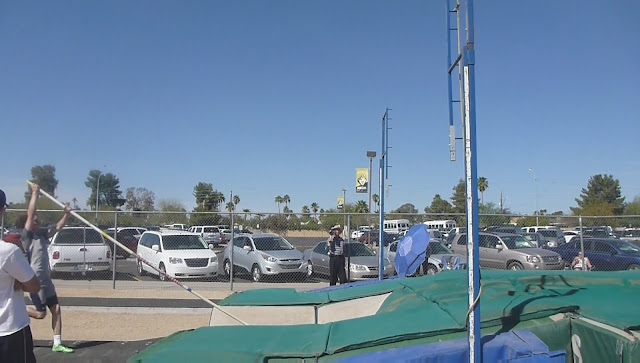
Hohokam Invite out in Mesa.. really hot - i think it was over 100 degrees.  girls opening height was 7' and the girls had a rough morning.  Boys opening height was 11' - which is both stephan and zach's PR, so having that as opening height was a bit daunting, but they both stepped it up for the competition and cleared! officially adding their name to the BCHS record books

Stephan 11'
attempt 1
attempt 2

Stephan 11'6"
attempt 1
attempt 2

attempt 3

Zach 11'
attempt 1

Zach 11'6
attempt 1
attempt 2

attempt 3

Wednesday, April 18, 2012

End of a season

I just want to say that i am proud of each one of you this season. There isn't one of you that hasn't improved in some aspect since day one.  I hope that you all want to continue your vaulting in the future.

a few notes - there are pole vault camps over the summer if you are interested. www.skyathletics.com is a close one that is well done. As far as our summer schedule, i will be in contact about summer stuff if it happens. The powers that be want to put our pits away to keep them in the best condition possible.  we might be able to pring the old ones back, but thats a conversation for me to have with the school.

SO - we went to Denny's - gwen and jake, you were missed :(

Here are a few photos.  i will have videos of the past few meets up soon - they take time to edit and organize and sometimes life gets in the way - i apologize - soon - k.  


Tuesday, April 3, 2012

Technique of the Vault

Technique of the vault
The approach
During the approach the pole vaulter sprints down the runway in such a way as to achieve maximum speed and correct position to initiate take-off at the end of the approach. At the beginning of the approach the pole is carried upright to some degree, and gradually lowered as the vaulter gets closer to the landing pit. The faster the vaulter can run and the more efficient his/her take-off is, the greater the potential energy that can be achieved and used during the vault. It is common for vaulters to gradually increase running speed throughout the approach, reaching maximum speed at take-off. Vaulters increase stride frequency while keeping the knees up like a sprinter. Unlike short sprint events such as the 100M in which a forward lean is used to accelerate, vaulters maintain a more upright torso position throughout the approach to counter balance the effect of carrying the pole.

The plant and take-off


The plant and take off is initiated about three steps out from the final step. These last three steps are normally quicker than the previous strides and are referred to as the "turn-over". The goal of this phase is to efficiently translate the kinetic energy accumulated from the approach into potential energy stored by the elasticity of the pole, and to gain as much initial vertical height as possible by jumping off the ground. The plant starts with the vaulter raising his arms up from around the hips or mid-torso until they are fully outstretched above his head, with the right arm extended directly above the head and the left arm extended perpendicular to the pole (vice-versa for left-handed vaulters). At the same time, the vaulter is dropping the pole tip into the box. On the final step, the vaulter jumps off the trail leg which should always remain straight and then drives the front knee forward. As the pole slides into the back of the box the pole begins to bend and the vaulter continues up and forward, leaving the trail leg angled down and behind him.


The swing up

The swing and row simply consists of the vaulter swinging his/her trail leg forward and rowing the pole, bringing the top arm down to the hips, while trying to keep the trail leg straight to store more potential energy into the pole, the rowing motion also keeps the pole bent for a longer period of time for the vaulter to get into optimum position.


Once in a "U" shape the left arm hugs the pole tight to efficiently use the recoil within the pole. The goal is to carry out these motions as thoroughly and as quickly as possible; it is a race against the unbending of the pole. Effectively, this causes a double pendulum motion, with the top of the pole moving forward and pivoting from the box, while the vaulter acts as a second pendulum pivoting from the right hand. This action gives the vaulter the best position possible to be "ejected" off the pole. The swing continues until the hips are above the head and the arms are pulling the pole close to the chest; from there the vaulter shoots his legs up over the cross bar while keeping the pole close

the key to a great swing up is just that. Swing the straight, extended trail leg through, breaking at the waist just after the trail leg passes the pole. The swing continues until the feet are past the pole. The biggest mistake that vaulters make is to tuck the trail leg knee in. This absorbs most of the energy from the swing instead of putting it into the pole. Keeping the trail leg straight all the way through adds energy to the system and keeps the pole bent until you have finished the swing and are in the best position for the inversion.
"tuck and shoot", meaning you tuck the trail lag in and go into a ball, stops adding energy into the system and the pole starts to recoil before you have finished your swing. Now you are fighting to get into and stay in an inverted position through the end of the vault.


Extension/Inversion

The extension refers to the extension of the hips upward with outstretched legs as the shoulders drive down, causing the vaulter to be positioned upside down. This position is often referred to as "inversion". While this phase is executed, the pole begins to recoil, propelling the vaulter quickly upward. The hands of the vaulter remain close to his body as they move from the shins back to the region around the hips and upper torso.
The inversion phase is all about "popping" the hips through. The shoulders should drop back naturally if you can concentrate on the popping the hips through all the way to vertical. The bottom arm collapses to the inside of the pole. Core strength is the key for this phase.

Pull/Push/Turn

the next phase is a pull - turn - push movement. The PULL: This key is to keep moving and keep yourself aligned with the pole, moving straight UP for as long as possible. This is where the core strength is required to hold yourself in a straight vertical position for as long as possible. The TURN: As the name implies, the vaulter turns 180° toward the pole while extending the arms down past the head and shoulders. Typically the vaulter will begin to angle his body toward the bar as the turn is executed, although ideally the vaulter will remain as vertical as possible. A more accurate description of this phase of the vault may be "the spin" because the vaulter spins around an imaginary axis from head to toe. Only when you have almost stopped moving up should you break at the waist and turn over the bar. The PUSH: After turning, one continues to move up the pole vertically and starts to push with their arms as if doing an inverted push up. This stage gains important height needed for the next step which is clearing the bar, facing it.

Saturday, March 17, 2012

Huskie Invitational 3/16

It was going to be a long hot day.  Jasmine, Zach, and Stephan attending.

meet results  http://www.athletic.net/TrackAndField/MeetResults.aspx?Meet=146531

Jasmine:
Opening height was 6' which would be a PR. shin splints still an issue (which will be rested and STRETCHED over spring break...right?) please come to compete. you looked defeated before your first jump. pole vault is 90% mental. if you're not in it to win it, you will not get far.  You are still hesitant of not "making it" to the pit, and because of this you jump to the pit instead of UP.  get over the fear and find the confidence this week.  Pole vault is difficult, and scary, and crazy, but you chose it because its fun, challenging, and unique. remember that and remember that you CAN do it.


Stephan (12th place) http://www.athletic.net/TrackAndField/Athlete.aspx?AID=936515

Please look at the difference between when you jump UP versus OUT... look at the pole bend and its position during those different jumps.  Also start to notice how high you are above things when you do jump up.  look up videos of the turn over to start to understand the concept.  you can do backward somersaults to a handstand for practice, but at the top of the handstand, twist and land the other direction... you have talent, we will find the skill. As far as this competition goes, i thing there were WAY too many approaches made.  2 at this height 3 at this one, 3 here 3 there, by the time you are at new heights, you are too tired to be able to give 100%. i understand that you are new and like the comfort of the lower jumps to feel ok, but we will have to cut a few of those heights out from now on.  I would expect that in competition, you can jump at 100% 6-8 times. your opening height should be an easy 1st jump clear. same with the second. your third height should be tied with you personal record, which might take 2 jumps, leaving you plenty of energy for your NEW PR and beyond.

your standards were at 28 and that seemed to work for your jumps... but again its because you were jumping out more than up. they will ideally be at 22-25 when you jump up.

8'6

9'
look - you jumped up!

9'6

10'

10'6


Zach (9th place) http://www.athletic.net/TrackAndField/Athlete.aspx?AID=3095152

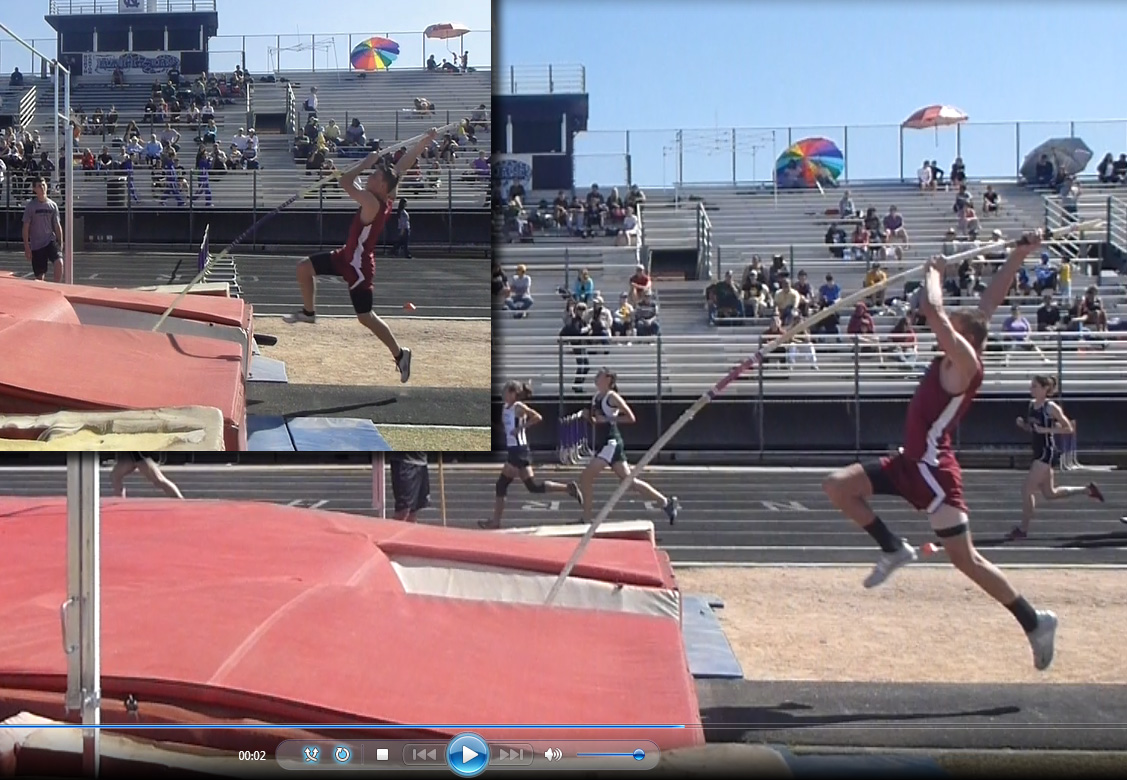
I think your opening height at 9'6 is good. the number of jumps for competition is resonalbel, leaving plenty of energy for the new PR heights. I am proud of your performance on the 150.  I know mentally its not your favorite pole, but it takes a lot to come out and be consitstant with many variables.  The quicker we can get the pop at the top, the quicker we can get off that pole and onto the 14' or the 13'7.  Congrats on reaching the top of a pole! that in itself is a hard thing to wrap the brain around since for the last two years, you have had at least a foot to the top. Be proud.  here are your videos followed by bo's run through and then a picture breakdown between the two of you... study it. Standards at 25 through all jumps i believe and it seemed to not be an issue.

9'6

10'

10'6


11'


BO -


Wednesday, March 14, 2012

BC vs Greenway 3/14 (happy PIE day!)

Alrighty, lets get on with it! good meet today.

BAR HIEGHT 5'6"
Alicia

Gwen 

Ari

Jasmine

BAR HEIGHT 6'
Jasmine

Ari

Jake

Jordan


BAR HEIGHT 6'6" - 7'6" i got confused in the videos so i cant remember exactly what height we are at... the top of the standards are 12' so the extensions start at 8' so the second one down will be 7 or 7'6, and the thrid on down is 6 or 6'6

Ari

Jordan


BAR HEIGHT 8'
Brad


BAR HEIGHT 8'6"

Hy


Stephan


BAR HEIGHT 9'
Stephan - please start looking at your plant during the misses versus the plant on a clear.


BAR HEIGHT 9'6"
Zach

Stephan


BAR HEIGHT 10'
Zach and Stephan competing for first and second!

Zach - good job not thowing your head back, we need to keep you bottom arm straighter for a bit longer, but thats going to have to mean moving your step back... more. your step should be at the cone, fyi.  four jumps... only the first three counted. the last two are on the 13' 150... check how the pop is quicker, which since you are still getting used to the amount of time in the air will benefit you.


Stephan - WOW, jumping at 10'!!!! good job - thank you for straightening out your plant to land in the pit... much safer that way.  Look at the second jump -- you ALMOST had it! too bad the fourth one doesn't count eh?  We will work on form more with you and learning to control each aspect of your jump.

Saturday, March 10, 2012

North Canyon Invitational 3/10/12

First invite of the year! attending: Brad, Zach, and Scott.  Results page http://www.athletic.net/TrackAndField/MeetResults.aspx?Meet=148554
Opening height was 9'.

Brad: Had to have a new PR just to make opening height.  Been working on trying to stop the lower hand from dropping to control the bend. i think we might keep working on that - also, getting a step that isnt under might help. First jump was from 5 lefts. 2nd and 3rd from 6 step.


Zach: Came in at 9'6". running from his 7 step, which this year has moved from 81 to 85 feet... due to running ability and a higher hand hold.  jumped on the 13' 140, then borrowed the 12'6 150 from deer valley for 10' and 10'6"... which we had that pole. we will work next week on finding a pole he can use that is in our inventory as well as continuing the upward shoot and shoulders to drop and the bottom arm at the plant.  Deer valley will bring the 12' 150 to Horizon invitational on friday for us (and remind me that we will be bringing the 14' 145 for bo) ... i will work on my filming skills...

9'6
10'

for some reason, the end of the video cut off, so here is the full size...full length. i think this was your best vault. look how far above 10 you are... imagine if you turned sooner... that would be a 12'6 to 13' jump... good enough for some glasses. :)


10'6

11'


Scott: Coming off an injury of the hip flexor (which i hope is on the mend) (and from the plant i see, i think it is) scott was running from his 5 step and using his 165 13' pole.  hopefully friday we can work on moving back to the 7 step and the 170/175 pole.  This week we wil be working on dropping the shoulders so the pole can recoil and shoot up instead of out.

11'6


Extra note... side by side plant photo: